Showing posts with label Debt. Show all posts

Tuesday, November 4, 2014

GO TO THE SOURCE

Clarity From Those Who Know


   Anything repeated enough times will eventually become accepted as fact, or truth. I’m afraid this is what has happened with respect to public understanding of our city’s debt. Why has this matter become an issue? It’s election time and for some it has become valuable fodder for their attempts to attract voter support. No one likes debt, and if there is one thing that might touch a raw nerve with the public, it is the thought that not only does their city have a debt, but that it has a large debt resulting from mismanagement by the Council in office, and furthermore, there is no plan to repay it. At least that is what the public is told.

   I won’t fill this space with a discussion about the pros and cons of carrying a debt, nor about how much capacity the city may or may not have to carry its debt. I want to address two issues here: the size of Abbotsford’s debt; and in particular, what qualifies as part of that debt.

   There is a fairly wide-held belief that Abbotsford has a debt of $102m. Part of the reason for this is that a sitting councillor, Henry Braun, has repeatedly expressed that opinion, while acknowledging that his Council colleagues don’t agree with him. So he shares part of the blame, but he is entitled to his views on this matter. The other Councillors, as well as our finance department don't agree with him.

   In fact, the long-term debt of Abbotsford stood at $78m at the end of 2013, a repeated point of fact supported by audited statements in the city’s Annual Report. The larger figure is arrived at by adding the $24m in “internal borrowing”. For the edification of all, I solicited information from the City’s finance department and received the following from the Assistant Director, Finance:

   “Internal borrowing is not debt, because the City has no obligation to repay anyone; only to use DCCs, as they are collected, to replace internally borrowed funds. What the City has done, is advance existing available cash to cover the costs of critical infrastructure projects. The City is being paid back by developers for that advance, plus interest, as development occurs. The end result is that all interchange funds “internally borrowed” will be fully repaid, with interest, by DCCs. Taxpayers will not have paid a penny to cover DCC internal borrowing on the interchanges. The alternatives to internal borrowing would have been to: 

§  (1) defer the interchange projects at the risk of traffic safety and at the risk of losing senior government grants worth over $30 million, or

§  (2) ignore the fact that the City had available cash on-hand and choose to finance the interchanges by issuing debt, which would have come at a much higher cost (interest rate) than the use of internally available funds. This option would have resulted in actual debt on the City’s balance sheet, but this debt, like the internal borrowing, would have been covered by DCC contributions, meaning taxpayers would not pay any of the cost.

o   Additional benefits from undertaking interchange projects and receiving government grants – The initial scope of the Clearbrook interchange project was completed over $7 million under budget. As a result, the City was able to redirect unused senior government funding to other roads, sewer, water, and storm drainage improvements in the vicinity of the Clearbrook interchange and obtain $7 million worth of senior government funded improvements that would otherwise have been costs Abbotsford taxpayers and/or developers.

o   5-year liability limit – There have been questions regarding whether or not there is a requirement to repay internal borrowing within 5-years. This question is based on Section 175 (2) of the Community Charter, which requires City liability agreements exceeding five years to be approved by referendum. Section 175, however, does not apply to internal borrowing, as it is not a debt obligation to the city, but an internal cash management decision. The relevant section is Section 189 (4.2), which requires that internally borrowed funds be repaid, with interest, no later than when it is required by the lending fund. There is no five year limit. The City has been projecting for some time that funds will be repaid by 2017 or 2018, and results to date in 2014 continue to support that timeframe as a reasonable projection.

The question of size of our debt and the plan for repaying it has been dealt with in another recent post:

The Truth About Debt

Further to this, Bill MacGregor has just published additional information on this topic, on his Blog site. 


Sunday, November 2, 2014

MY RESPONSE


In Response to Questions from AbbotsfordFirst

    Many of the questions asked require assistance from staff. That can be a time-consuming task, and if an opportunity presents itself, I can pursue those answers, Having said that, I think the point here is not an answer to every single question, but evidence that there is transparency and that nothing is being concealed. In fact, I suspect this exercise is a 'smoke screen' to deflect attention from more serious issues.

1.   At the Plan A Referendum Public Information Session held in 2006 at the Matsqui Centennial Auditorium, Dan Bottrill, City Finance Manager, stated that the City of Abbotsford was projecting a Property Tax Surplus of $4 million for 2007.

Answer: Really? 2006 – you want to address issues from 8 years ago? Only 4 of the present Council members were on Council at the time. What I don’t see here, which AbbotsfordFirst still claims on their website (Fred Thiessen’s press release) even after being reminded on numerous occasions that it is incorrect, is a statement that the City was debt-free in 2006. I challenged each of the candidates as far back as August (excluding Sandy Blue), as well as Fred Thiessen, to substantiate the claim, but no one responded to my emails. In 2006, the City had a debt of $38.4m. The closest the City came to being debt-free was 2004, when the long-term debt stood at $16m. This is but a small example of knowingly misleading the public. Trust? Integrity?

1.    Debt levels at that time are unknown to the public because Financial Statements prior to 2010 are unavailable on the City web site. In fact, hardly any financial data allowing us to compare our current financial state to that of the city before Plan A is possible. If you have access to all those Statements, please allow the public to have that same access so we can compare and decide for ourselves. We can tell you that housing starts before 2009 averaged 1100 per year. After that it has been abysmal... 2009 (365), 2010 (516), 2011 (537), 2012 (371), 2013 (749). Comparing 2013, our best year in the last 5 to 2008, we see a 40% decrease in housing starts. If you've managed our local economy so favourably, where has all the investment gone? Account for this decrease in performance? (Source: Canadian Mortgage and Housing Corp)

Answer: I‘ve seen stats posted by AbbotsfordFirst, referencing Ministry sources – the same sources where you will find that information. However, my Blog does have that information, taken from the Ministry site, and you are welcome to save time and find it there.


And with respect to housing starts, I don’t believe I or anyone else for that matter, have disputed any statements made on the subject. In fact, I don’t recall seeing statements made anywhere else, other than in this post. You are right, the world economy took a huge nose dive in 2008, and we have not resumed the performance level in place prior to the downturn.

3. Total debt - Firstly, we are unsure why you balk at $100 million in debt, but you seem to think that $78.4 is OK. Please tell us why you think so. Secondly, you are not including the $24 million internally borrowed (DCCs). Mr. Loewen claims that money is moved back and forth between City accounts all the time. Setting aside the fact that doing that anytime you want is against the Local Government Act and the Community Charter, this debt is not the simple moving back and forth of money. This money was largely spent on the 2 overpasses on Hwy 1 and those overpasses were not in the city's budget. This means we have taken money out of our DCC fund that should have been spent on other roads, infrastructure upgrades and expansions. That other work still needs to be done. This is called an infrastructure deficit. Every time you take future DCC money and use it to pay for this expenditure of the past, you are not paying off debt, you are simply paying off one credit card with another. At the end of the day, taxpayers will be burdened with this rolling liability. How will you deal with this infrastructure deficit of $24 million?

Answer:
1.     I’ve never said that any debt is ‘OK’, as you put it. In fact, our long-term debt has been reduced by 25% over the last 6 years (a 25-year mortgage at a very favourable fixed-interest rate until maturity). I should also add that the cost of servicing our long-term debt (principal and interest) consumes less than 5% of our annual operating budget. As a home owner, I would have loved a mortgage that only required 5% of my income. Today, homeowners are lucky to stay below 30%.

2.     Drawing on Reserves is not considered debt and financial statements make that clear. If you can’t accept that fact,  I suggest you take your argument to KPMG or our city manager, Mr. Murray, who I’m sure would be more than happy to provide some enlightenment.

3.     My response is clearly laid out in one of the posts deemed irrelevant. Your words,  “…none of your posts actually answer any of the questions. The post I’m referring to is “Take Your Choice”. http://councillorloewen.blogspot.ca/2014/11/take-your-choice.htmlhttp://councillorloewen.blogspot.ca/2014/11/take-your-choice.html

4.     Reserves are like Savings Accounts, in which monies are set aside for a specific purpose. The Charter does not forbid drawing on those Savings, but does say that those funds must be restored to that account as soon as they are required for their intended use.

5.     To summarize very briefly the post referenced in #1 above, the City leveraged Savings to get $50m. of “free” money (never having to repay it), so that our infrastructure deficit, as you refer to, might be addressed without burdening taxpayers. Your objection appears to favour the latter option. I don’t know how else to interpret it.

NOTE: Since writing this article, I've been in conversation with Finance staff, and they provided what I believe is a very concise and definitive statement on this issue; City debt WAS $78m. at end of 2013. Their statement is found at the following link:

                       To the Source  -  Of Course!

6.     Additionally, the idea of paying off current DCC debt with future DCC revenue has led Council to raising DCC's to the highest rate we can find in the Valley. Our DCC rate is approximately $29,000 per lot, whereas Langley is $21,000 and Burnaby is $7,000. The result has been a huge downturn in housing starts. In 2008, we had 1285 starts. In 2012, we had 371 and 2013 we had 749. In the 2013, the City projected $18 million in DCC revenue and it only collected $3 million. How was that revenue made up? All departments set their budgets against expected revenue so when $15 million doesn't come in, something must be cut. What was cut?

Answer: Comparing Abbotsford’s DCC rates with municipalities within Metro Vancouver is difficult.  Metro Vancouver’s DCC rates have not been updated for many years and they have made a decision to fund significant regional infrastructure through user rates as opposed to DCC rates.  This means all existing taxpayers pay for growth related items as opposed to new development.  Abbotsford Council has taken the position that growth should pay for expansion of new infrastructure. 

With respect to specific rates, I am unable to provide an answer as I’m not conversant in this matter, nor is that information easily available. That doesn’t mean the information can’t be accessed, it’s just not at my fingertips.

7.     You mention a strong cash position. Any excess cash coming to the City of Abbotsford is due to "inflated" DCC's, an 80% + increase in Water Rates from 2010 to 2012, a 43% Property Tax increase since 2006. Taxing your citizens to pay for your mistakes is not strength. Can you clarify for the citizens of Abbotsford why these rate increases are so high if your stated surplus and financial position is so strong.

Answer: Of that 43% increase (assuming your figure is correct), approximately 16% was the result of the Plan ‘A’ capital projects, which residents of Abbotsford approved in a referendum. That would leave 27% over 8 years, which translates to approximately 3.5% per annum. Clearly, too high an increase, as the last two years have been at or near zero. And for the record, I don’t think I or anyone on this Council has stated that those increases were acceptable. If you are going to revisit the last 10 years, I suggest you revisit the last 20, starting with amalgamation. Councils of the first 10 years were ultra-conservative, resulting in a significant infrastructure deficit that could not be ignored. Even while the City was growing rapidly, Councils were reluctant to spend in order to meet the challenge of a rapidly growing city.

There is also an implied comment in the question that Abbotsford property tax is excessively out of line with its neighbouring municipalities. In response, I would draw your attention to the two graphs in the following post:

http://councillorloewen.blogspot.ca/2014/10/property-taxes.html

8.       You mention the city has $130 million in cash or equivalents. "Equivalents" is meaningless Mr. MacGregor...that is like saying I have $100 in cash and coupons. What matters is the cash. In the 2013 Financial Statement, on page 2, the page the Mayor signs, it clearly states on line 1 that "Cash and Cash Equivalents" equal $21 million. No line item anywhere in the Financial Statement shows $130 million.

Answer: Surplus/Reserves - $94.1m.; DCC’s - $14m.; and deferred revenue - $21.1m. 

7.    Last year when the City of Abbotsford was thinking about giving the YMCA $17.5 million, the Finance Department issued a report to Council stating clearly that they only had $14 million available, and then they offered alternatives on how to make up the difference.

8. We would like to point out that you cannot add our Statutory Reserve to this amount because you are not allowed to spend that.
Answer: With respect, under the Charter, local governments can use those funds, but must restore within stipulated time frame; see #3 above.

9. On that same page of the 2013 Financial Statement, there are also liabilities listed. You cannot exclude those from your calculations. The NET FINANCIAL ASSET for 2013 is $9 million...and this comes after 2012's $12 million NET DEBT. This is not $130 million in the bank. This is the true financial picture of the City of Abbotsford.

     Answer: As you point out, the City had a Net Debt of $12.4m in 2012, followed by a Net Asset of $9.4m in 2013. That is a $21.8m turnaround, and projection for 2014 is similar to 2013. This is the result of two years under the management of a new CAO, who has executed Core Service Reviews in most, if not all departments and made significant changes in staffing structures and found efficiencies that had eluded previous administrations. 

10. Next you seemingly change the long term debt from $78.4 million to $40 million so that you can claim we aren't being accurate? Please answer for this inconsistency in your statement. No Financial Statement by the City of Abbotsford, nor any statement by Abbotsford FIRST includes the number $40 million. Only you use this number and yet it is used to illustrate that in your tenure you've doubled our long term debt. Explain why you would attempt to represent a $78.4 million debt as $40 million to the citizens of Abbotsford?

Answer: The paragraph you refer to is a layman’s rough estimate and interpretation of reality, with respect to the countless projects completed in the last 8 years (roughly totally in excess of $200m.) against the real debt at the end of those 8 years, leaving a net increase in debt of about $40m. These are not accountants figures, nor would I expect Mr. Murray would ever refer to that activity in these terms. If you choose to take issue with our rough guesses, I for one will choose to ignore such concerns.

11. The are also questions that you and all incumbent Councillors must answer Mr. MacGregor. With one of the highest Property Tax rates in the Province of BC, with the highest unemployment rate in Western Canada, with dwindling housing starts and businesses closing every day, and a 9 year track record of nearly every major economic indicator resulting in a decline, what are you going to do to stimulate Abbotsford's economy? Please post your plans for the economic development of Abbotsford. As an incumbent, you have far more access to information and a comprehensive plan would be appreciated.

Answer: One of my Blog posts took issue with the erroneous use of “Tax Rates” as a comparator. 

http://councillorloewen.blogspot.ca/2014/10/assessed-value-taxrates-and-total-tax.html 

I’ve responded to numerous people over the years, and still, they/you don’t get it. This is not me saying this, but Finance staff with whom I have consulted. A cursory review of a few BC municipalities would make the point quite obvious to most people. There is a common sense reason why the Provincial Government does not use ‘Rates’ to compare one municipality with another. If rates were significant, then why would West Vancouver and Whistler have the lowest tax rates in BC, while far northern communities the highest? Are you suggesting that taxes in the far North are that much higher than West Vancouver and Whistler?

I will however, humour you for the moment, and accept that our “high tax rates” are a problem to address, and ask you to account for the discrepancy between the high tax rates and the fact that Abbotsford’s property taxes compare so favourably with the other Fraser Valley and Lower Mainland municipalities, including West Vancouver (highest).


12. The City of Abbotsford committed to giving the Abbotsford Heat $5.5 million to leave our city. Where is that money coming from? What will be cut to provide that capital? It wasn't in our budget so it is "new" money. Where will you get it from?

Answer: My recollection is that the funds came from accumulated surplus; I would have to check, because I am not certain. It should also be noted that the City's share of the revenue from Chances Gaming Centre (almost $1m annually) has been allocated to the AESC.

13. If you're answer is from the Surplus you are generating from "inflated" taxes and rates (language used by your own Finance Department in 2013), the result has been a city with one of the lowest growth rates in the Lower Mainland. How will you rectify this lack of performance and attract business, investors and jobs?

Answer: First of all, it would be proper to reference your sources, especially comments regarding language used by Finance personnel). If you were listening to the mayoral debate this week, you should have heard the Mayor reference a number of initiatives that will have a positive influence in terms of addressing the concerns you mention: DART, revised and consolidated Zoning Bylaw, and the OCP review now underway. George Murray has been doing a Core Services Review over the last 2 years, resulting in key hires, reorganization, and finding efficiencies that have resulted in observable improvements with respect to “welcoming business”. These challenges do not disappear in short time spans, but take longer for the change to become apparent.

Those reviews have also resulted in two successive years with modest surpluses of $10m. last year, and $7 - $10m this year. Those funds have and will continue to be applied to DCC funds and/or short-term debt.


I have not responded to every single question, however, I think most of them have been covered. More detail on questions regarding DCC rates, etc, are all available, however, it will take some digging, as I have done. 

Saturday, November 1, 2014

TAKE YOUR CHOICE

Option #1 or #2?


   Criticism is easy – it’s the decision-making that attracts criticism that is difficult. Are mistakes sometimes made? They most certainly are and hopefully, lessons are learned in the process. I welcome constructive criticism, but when criticism is only that, I become disinterested in listening. That kind of criticism is often just a cover for the critic’s own shortcomings, whatever they may be.

   Over the last year, and particularly now, during the election campaign, the topic of drawing on the City's Reserve funds to construct the two interchanges has been often raised. It is that issue I wish to address here.

   In 2008, the world economy went into a serious recession. Within the year, our federal government realized intervention was needed, and they launched the Economic Action Plan to generate jobs. Grants were offered across Canada to invest in infrastructure. The government wanted ‘shovel-ready’ projects, and offered one-third funding, contingent on the provincial and municipal governments each contributing one-third as well.

   It must also be noted that the federal government was in the practice of not making their one-third contribution until completion of the project. The choice that Council of the day faced was: 1) turn the offer down, or 2) draw on Reserves to provide our one-third of $50m. (each interchange was priced at $25m.). Council chose the latter option.

   Both projects were completed under budget, with the Clearbrook interchange significantly under budget. On the Clearbrook project, the City built it with its own supervising Engineer. A total of 21 local companies were awarded contracts in the construction of that interchange, creating employment for many local workers, and thereby providing for their families during a very serious economic downturn.

   In both cases, the City could have settled for the lower cost and saved money in the short-term. However, the City requested that it be permitted to apply those saved dollars to other necessary infrastructure projects. The federal authorities agreed on condition that the projects would be “connected” in some way to the two interchanges.

   At the McCallum interchange, the most significant additional work was the climbing lane on the freeway, between Sumas Way and McCallum Road, where traffic bottlenecks were common. Additional projects included the McCallum parking lot and bus stop, as well as some water/sewer infrastructure. At Clearbrook, where much more money was saved because the City did the building and contracting, significant road infrastructure was completed, namely, Clearbrook Road, from the interchange to King Road; and Marshall Road, from the traffic circle to Mt. Lehman Rd.

   That entire extra infrastructure was paid for on the basis of 33 cents to the dollar, instead of having property taxpayers shoulder the complete cost of constructing, which would eventually have to happen. Our citizens were saved millions of dollars in property taxes. Criticism is often based on only part of the story, at the expense of the truth – the other part of the story. 

   I haven’t mentioned the airport infrastructure improvements, which also entailed a $25m. investment, and also including additional work due to completion under budget. The new terminal is the result of those extra dollars, with the Airport Authority picking up only 33 cents-on-the-dollar costs.

   In all my difficult decision-making at the Council table, I am guided by the principle of what is in the best interests of the community at large. There were two options: Council chose the latter; based on the criticism leveled, I assume the critics would have chosen the former. I’ll gladly take the criticism; in this case, the City certainly benefited. I take encouragement from the words of Aristotle, who said:

“To avoid criticism say nothing, do nothing, be nothing.” 


Tuesday, October 28, 2014

CITY FINANCES

City Financial Outlook


   The city’s financial outlook is not as bleak as some would have you believe, and to say the city has no plans to restore finances to previous levels is simply an ignorant statement, by which I mean, the author of that statement failed to do some basic research.

   In 2013, the city generated a $10 million surplus, and this year, the surplus is projected at between $7.5 million and $10 million. It’s exactly for that reason that the city was able to hold the tax increase for 2014 to a 0% increase, the first time in at least 15 years. That required planning.

   As at December 31, 2013, the city had nearly $130 million in cash or cash equivalents, comprised of surplus/reserves ($94.1 M), DCC’s ($14 M), and deferred revenue ($21.1 M). This information is readily accessible in the city’s audited annual financial statements. Long-term debt existing from before 2006 has been repaid on an accelerated basis due to the city’s strong cash position. That required planning.

   I’ve written about the city’s debt in a previous article, but will repeat some of that here, to give the reader a more complete picture of the city’s financial state of health. The city has not been debt-free, at least as far back as 1997. In 2006, the long-term debt stood at $38.4 million, down from $45 million in 2005. Audited financial statements show that Abbotsford had $78.4 million in total long-term debt at the end of 2013 (projected to be approximately $73.0 million at the end of 2014). This long-term debt, which has a very favourable fixed interest rate until maturity, is almost entirely related to the three Plan ‘A’ projects, which were approved by the citizens in a referendum.

   In the last eight years, the city has managed to complete significant infrastructure projects and capital improvements totalling well in excess of $200 million, while long-term debt increased by a net of only $40m million. That required planning. The list includes: expansion to ARC, Discovery Trail, the Reach Gallery/Museum, Abbotsford Centre, McCallum and Clearbrook interchanges (our portion was 1/3 cost on each), Airport improvements (1/3 cost), Whatcom Road Connector, new Firehall, impoving and raising Dikes, new library, land acquired for Mill Lake Park, upgrade of water mains, upgrade of James Treatment plant, drilling of Bevan Wells (emergency supply when Norrish Creek water line became disabled in 2013), and upgrade of all-weather fields. This does not include all the annual capital projects accounted for in departmental budgets, such as Engineering annual $5 million Roads budget.

   It must also be noted that the two interchanges were completed well under projected budget costs, allowing the city to construct the climbing lane on Highway #1, between Sumas Way and McCallum Interchange, and to make the significant road improvements to Marshall Rd. between Clearbrook and Mt. Lehman Roads, and Clearbrook Rd. south of the interchange to King Rd. These capital projects would normally have been entirely funded from city funds; however, in this case the city’s cost was only one-third of the total cost. Moving forward, in the short term, the city will need to focus on the replenishing of funds used from DCC funds to complete the two interchanges.


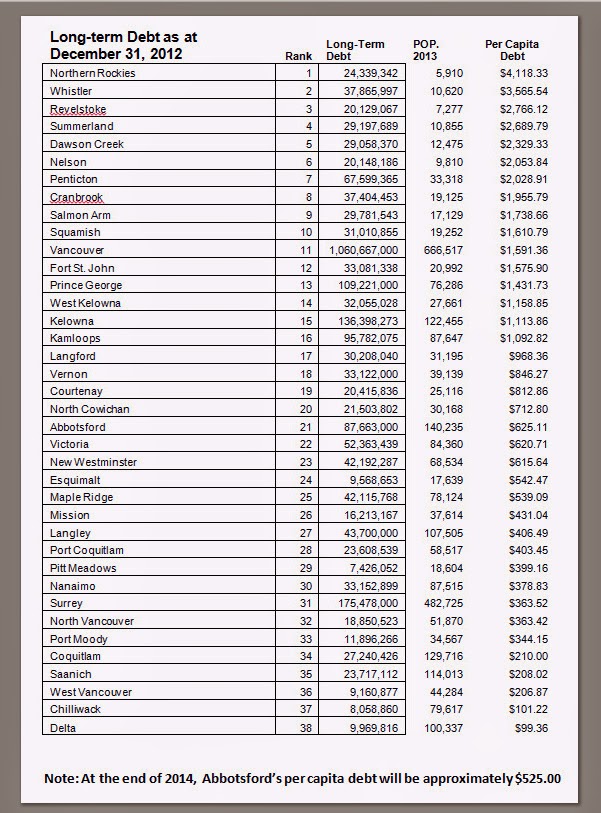
   The above table is based on the latest available data (2012) supplied by the Ministry of Community, Sport, and Cultural Development. On a debt per capita basis, Abbotsford is ranked 21st in the province. Based on the projected long-term debt of $73 M. at the end of 2014, the figure will be approximately $525/capita.

   What needs to be noted with these figures, with respect to metro municipalities, is that Metro Vancouver debt is not factored in. In 2012, Metro Vancouver had a debt of $370 M., which is shared by all its member municipalities, on a per capita basis. This debt relates to their shared utilities: water, waste, housing, and corporate programs. This would include 11 of the municipalities on the table that show lower per capita debts than Abbotsford.


   While my background is not in the financial world, it is my humble opinion that the city’s financial position is under very good control; infrastructure is in good shape; and the city is poised to make continued progress in terms of strengthening our financial health. 

Wednesday, October 8, 2014

OUR CITY DEBT

The Truth About Our Debt


   Let's get one thing straight at the outset - I don't like debt, and I don't believe anyone else likes debt, but like life, it happens!

   I've read numerous opinions about the City's debt, including some erroneous facts. Unfortunately, too many people accept those opinions rather than checking against reliable sources. If you should doubt me, please do corroborate what I state against City Annual Reports and provincial ministry stats (where most of my information comes from).
                             http://www.cscd.gov.bc.ca/lgd/infra/statistics_index.htm

   Abbotsford and Matsqui amalgamated into one municipality in 1995; my data includes the years 1997 to present, so when I say Abbotsford has never been debt-free, I am assuming it had a debt in the two years immediately following amalgamation.

   It is has been publicly stated that Abbotsford was debt-free in 2006, which simply is not true. The City had a debt of $38.4m. The closest the City came to being debt-free was 2004 ($16m.). Of course that debt was greatly increased as a result of the elector-approved capital projects (Plan 'A'), resulting in a maximum debt, in 2008, of $104.8m. Today, the City's long-term debt stands at $78.4m. as of December, 2014. I need to acknowledge an error in an earlier post, on this topic, in that I stated debt figures that are not in agreement with the data I cite here.

   The debt has decreased by 25% over the last six years, which correlates with the fact that part of it has been amortized over 25 years (The Reach portion was amortized over 20 years). Like any homeowner, one always considers capacity for carrying debt and how much debt is reasonable to carry. In the City's case, debt principle and interest costs amount to less than 5%, annually, of the City's total budget.


   At the end of 2013, Abbotsford's per capita debt was $625, and will be approximately $525 at the end of this fiscal year. How does this compare with other municipalities? Twenty other municipalities have higher debt burdens, with most of those in excess of $1000. As I said at the outset, I am not advocating for continued debt. What I am trying to convey here is that we have never been debt free; we have a debt resulting from elector-approved capital projects; we have a plan to pay it down (called a mortgage); and that the debt is not more than Abbotsford has the capacity to carry.


Monday, April 21, 2014

How Bad is Abbotsford's Debt?


In a column published in Abbotsford Today (April 21, 2014), Jordan Bateman calls for an independent audit of Abbotsford’s finances, believing that the whole “story” has not been revealed, specifically with respect to the Heat contract. I too, would be curious to know if such an audit would vary from that of the annual audits done by KPMG, which are reported to the public.

The point Mr. Bateman makes, in his article, about Abbotsford’s debt is what attracted my attention and provoked me into returning to the provincial data (which Mr. Bateman chose not to do for reasons I do not know), doing some basic research related to municipal debt loads throughout the province, and in particular, the Lower Mainland.

Abbotsford’s ‘Total Long-Term Debt’ at end of 2012 was $87,663.00 and at the end of 2013, it was approximately $79,000.00. Mr. Bateman quotes my article of a year ago in which 2011 stats were applied. Since then, Abbotsford’s status has changed to 6th highest debt.

What is of more importance and interest is the per capita debt one finds when doing some basic sleuthing and math calculations. The following table highlights only 38 municipalities, which represent most of the municipalities with significant debt. With a little more time and effort, I could have produced a table that would have included the entire province. This table, however, will suffice to make the point that debt expressed in terms of dollar value only, is a very small part of the entire picture. The table provides some comparison in terms of capacity to carry a particular debt.

601.1 - Long-term Debt and Debt Charges as at December 31, 2012
Rank
Long-Term Debt
POP. 2013
Per Capita Debt
Northern Rockies
1
24,339,342
$4,118.33
Whistler
2
37,865,997
10,620
$3,565.54
Revelstoke
3
20,129,067
7,277
$2,766.12
Summerland
4
29,197,689
10,855
$2,689.79
Dawson Creek
5
29,058,370
12,475
$2,329.33
Nelson
6
20,148,186
9,810
$2,053.84
Penticton
7
67,599,365
33,318
$2,028.91
Cranbrook
8
37,404,453
19,125
$1,955.79
Salmon Arm
9
29,781,543
17,129
$1,738.66
Squamish
10
31,010,855
19,252
$1,610.79
Vancouver
11
1,060,667,000
666,517
$1,591.36
Fort St. John
12
33,081,338
20,992
$1,575.90
Prince George
13
109,221,000
76,286
$1,431.73
West Kelowna
14
32,055,028
27,661
$1,158.85
Kelowna
15
136,398,273
122,455
$1,113.86
Kamloops
16
95,782,075
87,647
$1,092.82
Langford
17
30,208,040
31,195
$968.36
Vernon
18
33,122,000
39,139
$846.27
Courtenay
19
20,415,836
25,116
$812.86
North Cowichan
20
21,503,802
30,168
$712.80
Abbotsford
21
87,663,000
140,235
$625.11
Victoria
22
52,363,439
84,360
$620.71
New Westminster
23
42,192,287
68,534
$615.64
Esquimalt
24
9,568,653
17,639
$542.47
Maple Ridge
25
42,115,768
78,124
$539.09
Mission
26
16,213,167
37,614
$431.04
Langley
27
43,700,000
107,505
$406.49
Port Coquitlam
28
23,608,539
58,517
$403.45
Pitt Meadows
29
7,426,052
18,604
$399.16
Nanaimo
30
33,152,899
87,515
$378.83
Surrey
31
175,478,000
482,725
$363.52
North Vancouver
32
18,850,523
51,870
$363.42
Port Moody
33
11,896,266
34,567
$344.15
Coquitlam
34
27,240,426
129,716
$210.00
Saanich
35
23,717,112
114,013
$208.02
West Vancouver
36
9,160,877
44,284
$206.87
Chilliwack
37
8,058,860
79,617
$101.22
Delta
38
9,969,816
100,337
$99.36

The Ministry data tells only one part of the Lower Mainland Municipal Debt story. In addition to the debt figures provided by the Ministry, each of the Metro Vancouver municipalities carry additional debt that is not represented in this data, which leads to the question, how is Metro Vancouver funded?

The operating budget of the Metro Vancouver Districts is paid for by six main sources:
  1. Tax Requisitions
  2. Sewer Levy
  3. Solid Waste Tipping Fee
  4. Water Sales
  5. Housing Rents
  6. External Revenues, Reserves and Other
These revenue sources support four separate legal entities: the Greater Vancouver Regional District (GVRD) is funded primarily through tax requisitions of member municipalities, the Greater Vancouver Sewerage & Drainage District (GVS&DD) through a sewer levy for liquid waste and user fees for the solid waste function, the Greater Vancouver Water District (GVWD) through the sale of water to participating member municipalities, and the Metro Vancouver Housing Corporation (GVHC) through property rentals.

It is Metro Vancouver’s debt-load, however, which is of particular interest here. The following information is a year old, however, for purposes of comparison and for making my point, is useful. Each figure provided represents debt carried by Metro Vancouver for each respective departments:

Water Debt - $97M.
Water, Capital Programs & Projects - $156M.
Liquid Waste - $33.5 M.
Liquid Waste, Capital Programs & Projects - $47.8M.
Solid Waste - $3.8M
Solid Waste, Capital Programs & Projects - $14.5M.
Housing - $15.5M.
Corporate Programs - $1.5M.

Total debt of $370 M.

This debt is shared by all Metro Vancouver property-tax payers, through the requisitions made annually. Needless to say, the Ministry information that places Abbotsford at 6th largest debt is misleading in that the Metro portion is not included.

As for Abbotsford’s long-term debt, the Plan ‘A’ portion was amortized over 20 and 25 years, depending on the project, at very competitive interest rates. All other long-term debt will be paid by 2016. In 2006, Abbotsford’s total, long-term debt was $123,401,000; at end of 2013, it was $78,760,000 – a decrease of 36% over 7 years.


As noted earlier, not all municipalities were included in the table. Some, in fact, have a higher per capita debt than many in the list. If all were included, Abbotsford would fall even further down the list; here the City sits at 21st. I am not advocating for burdening taxpayers with large debts, however, I am realistic enough to know that some debt is often to be expected, and if the interest rates are competitive, and the tax base wide enough, the burden to taxpayers can be tolerable. Presently, debt payment (principle and interest) constitutes approximately 2% of Abbotsford’s Operating Budget.