Showing posts with label municipal finance. Show all posts

Wednesday, September 26, 2018

Ad Hoc Planning or Master Planning?

A city's OCP is a 30,000 ft view that lays out, in broad strokes, how the city is intended to grow or develop. It identifies land use and density. Master Plans are ground-level views that lay out in detail how that OCP will be executed. From water and sewer to transit, transportation, and parks, these plans prioritize action plans based on a number of factors, including needs, wants, and costs. 

The Parks, Recreation, and Culture Master Plan is a good example. Through extensive public engagement at two stages in the 4-stage process, staff learned what was important to the residents of Abbotsford, and the final draft reflected that to a great extent. Priorities were set accordingly, but not overlooking ongoing maintenance, population growth demands, and certainly financial feasibility. Priorities were organized into "Short", "Medium", and "Long-Term" action plans.

The master plan includes a 25-year financial plan that charts a path that can deliver an affordable plan that does not become a financial burden for taxpayers. As mentioned in the plans, if at any time grant funds become available, certain projects may be advanced more quickly. It must also be noted that master plans are always open for review and revision.


In the same way, each of the other eight master plans have been designed to facilitate more certainty and stability in how the city manages the financial and physical resources for its residents.

When candidates promise that upon election, they will deliver certain capital projects or programs, you need to ask them if and how it fits in the Master Plan, and how they propose to finance it. With respect to Parks, Recreation, and Culture, they also need to be asked how they will defend their decision before the public, whose input has greatly determined the priorities as set out in the master plan. And if they are willing to do this with one of the master plans, will they also apply that to the other eight? 

Will it be Ad Hoc Planning or Master Planning?

Saturday, November 1, 2014

TAKE YOUR CHOICE

Option #1 or #2?


   Criticism is easy – it’s the decision-making that attracts criticism that is difficult. Are mistakes sometimes made? They most certainly are and hopefully, lessons are learned in the process. I welcome constructive criticism, but when criticism is only that, I become disinterested in listening. That kind of criticism is often just a cover for the critic’s own shortcomings, whatever they may be.

   Over the last year, and particularly now, during the election campaign, the topic of drawing on the City's Reserve funds to construct the two interchanges has been often raised. It is that issue I wish to address here.

   In 2008, the world economy went into a serious recession. Within the year, our federal government realized intervention was needed, and they launched the Economic Action Plan to generate jobs. Grants were offered across Canada to invest in infrastructure. The government wanted ‘shovel-ready’ projects, and offered one-third funding, contingent on the provincial and municipal governments each contributing one-third as well.

   It must also be noted that the federal government was in the practice of not making their one-third contribution until completion of the project. The choice that Council of the day faced was: 1) turn the offer down, or 2) draw on Reserves to provide our one-third of $50m. (each interchange was priced at $25m.). Council chose the latter option.

   Both projects were completed under budget, with the Clearbrook interchange significantly under budget. On the Clearbrook project, the City built it with its own supervising Engineer. A total of 21 local companies were awarded contracts in the construction of that interchange, creating employment for many local workers, and thereby providing for their families during a very serious economic downturn.

   In both cases, the City could have settled for the lower cost and saved money in the short-term. However, the City requested that it be permitted to apply those saved dollars to other necessary infrastructure projects. The federal authorities agreed on condition that the projects would be “connected” in some way to the two interchanges.

   At the McCallum interchange, the most significant additional work was the climbing lane on the freeway, between Sumas Way and McCallum Road, where traffic bottlenecks were common. Additional projects included the McCallum parking lot and bus stop, as well as some water/sewer infrastructure. At Clearbrook, where much more money was saved because the City did the building and contracting, significant road infrastructure was completed, namely, Clearbrook Road, from the interchange to King Road; and Marshall Road, from the traffic circle to Mt. Lehman Rd.

   That entire extra infrastructure was paid for on the basis of 33 cents to the dollar, instead of having property taxpayers shoulder the complete cost of constructing, which would eventually have to happen. Our citizens were saved millions of dollars in property taxes. Criticism is often based on only part of the story, at the expense of the truth – the other part of the story. 

   I haven’t mentioned the airport infrastructure improvements, which also entailed a $25m. investment, and also including additional work due to completion under budget. The new terminal is the result of those extra dollars, with the Airport Authority picking up only 33 cents-on-the-dollar costs.

   In all my difficult decision-making at the Council table, I am guided by the principle of what is in the best interests of the community at large. There were two options: Council chose the latter; based on the criticism leveled, I assume the critics would have chosen the former. I’ll gladly take the criticism; in this case, the City certainly benefited. I take encouragement from the words of Aristotle, who said:

“To avoid criticism say nothing, do nothing, be nothing.” 


Tuesday, October 28, 2014

CITY FINANCES

City Financial Outlook


   The city’s financial outlook is not as bleak as some would have you believe, and to say the city has no plans to restore finances to previous levels is simply an ignorant statement, by which I mean, the author of that statement failed to do some basic research.

   In 2013, the city generated a $10 million surplus, and this year, the surplus is projected at between $7.5 million and $10 million. It’s exactly for that reason that the city was able to hold the tax increase for 2014 to a 0% increase, the first time in at least 15 years. That required planning.

   As at December 31, 2013, the city had nearly $130 million in cash or cash equivalents, comprised of surplus/reserves ($94.1 M), DCC’s ($14 M), and deferred revenue ($21.1 M). This information is readily accessible in the city’s audited annual financial statements. Long-term debt existing from before 2006 has been repaid on an accelerated basis due to the city’s strong cash position. That required planning.

   I’ve written about the city’s debt in a previous article, but will repeat some of that here, to give the reader a more complete picture of the city’s financial state of health. The city has not been debt-free, at least as far back as 1997. In 2006, the long-term debt stood at $38.4 million, down from $45 million in 2005. Audited financial statements show that Abbotsford had $78.4 million in total long-term debt at the end of 2013 (projected to be approximately $73.0 million at the end of 2014). This long-term debt, which has a very favourable fixed interest rate until maturity, is almost entirely related to the three Plan ‘A’ projects, which were approved by the citizens in a referendum.

   In the last eight years, the city has managed to complete significant infrastructure projects and capital improvements totalling well in excess of $200 million, while long-term debt increased by a net of only $40m million. That required planning. The list includes: expansion to ARC, Discovery Trail, the Reach Gallery/Museum, Abbotsford Centre, McCallum and Clearbrook interchanges (our portion was 1/3 cost on each), Airport improvements (1/3 cost), Whatcom Road Connector, new Firehall, impoving and raising Dikes, new library, land acquired for Mill Lake Park, upgrade of water mains, upgrade of James Treatment plant, drilling of Bevan Wells (emergency supply when Norrish Creek water line became disabled in 2013), and upgrade of all-weather fields. This does not include all the annual capital projects accounted for in departmental budgets, such as Engineering annual $5 million Roads budget.

   It must also be noted that the two interchanges were completed well under projected budget costs, allowing the city to construct the climbing lane on Highway #1, between Sumas Way and McCallum Interchange, and to make the significant road improvements to Marshall Rd. between Clearbrook and Mt. Lehman Roads, and Clearbrook Rd. south of the interchange to King Rd. These capital projects would normally have been entirely funded from city funds; however, in this case the city’s cost was only one-third of the total cost. Moving forward, in the short term, the city will need to focus on the replenishing of funds used from DCC funds to complete the two interchanges.


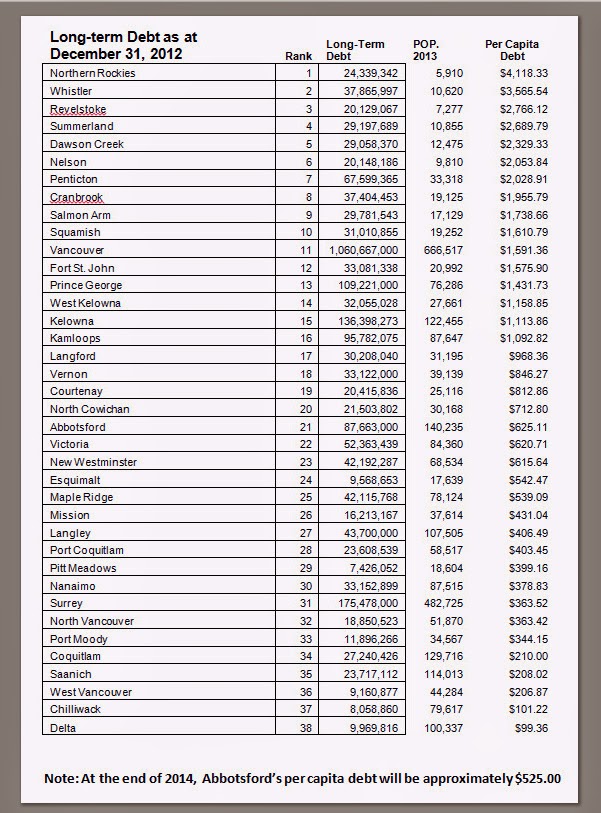
   The above table is based on the latest available data (2012) supplied by the Ministry of Community, Sport, and Cultural Development. On a debt per capita basis, Abbotsford is ranked 21st in the province. Based on the projected long-term debt of $73 M. at the end of 2014, the figure will be approximately $525/capita.

   What needs to be noted with these figures, with respect to metro municipalities, is that Metro Vancouver debt is not factored in. In 2012, Metro Vancouver had a debt of $370 M., which is shared by all its member municipalities, on a per capita basis. This debt relates to their shared utilities: water, waste, housing, and corporate programs. This would include 11 of the municipalities on the table that show lower per capita debts than Abbotsford.


   While my background is not in the financial world, it is my humble opinion that the city’s financial position is under very good control; infrastructure is in good shape; and the city is poised to make continued progress in terms of strengthening our financial health.